The Simple Tools We Use to Spy on Local Competitor Map Moves
In the high-stakes world of local search, there is an invisible war happening right under your nose. Every single day, your competitors are making subtle, calculated adjustments to their digital presence with one goal in mind: to push you out of the Google Map Pack. As a Google Business Profile Product Expert, I’ve seen this play out thousands of times. Most business owners view the Map Pack as a static list, but in reality, it is a living, breathing leaderboard that rewards the most strategic players.
When we talk about “spying” on competitors, we aren’t talking about anything shady or unethical. We are talking about data-driven competitive intelligence. To rank google business profile listings effectively in 2026, you cannot rely on guesswork. You need to know exactly what the guy down the street is doing – what categories they are choosing, how often they are posting, and where their “authority signals” are coming from. This guide will pull back the curtain on the exact framework and tools we use to dismantle local competition and claim the top spot.
Why Proximity is No Longer the Only King
For years, the “Proximity Myth” dominated local SEO discussions. The belief was simple: if a user is standing in front of your shop, you rank #1. If they move three blocks away, your ranking drops. While proximity remains a primary ranking factor, Google’s algorithm has evolved to prioritize “Prominence” and “Relevance” more heavily than ever before. This is why you often see a business three miles away outranking a business that is only three blocks away.
If your competitors have stronger authority signals – such as higher review velocity, better-optimized landing pages, and a more comprehensive citation profile – they can effectively “stretch” their proximity radius. In my experience, understanding The Proximity Myth: How to Rank Even When You’re Miles Away is the first step toward dominating a larger service area. If you only optimize for the people standing on your doorstep, you are leaving 90% of your potential revenue on the table. By spying on how competitors achieve prominence, you can replicate their success and bypass the physical limitations of your office location.
The Essential “Spy” Toolkit for 2026
To win the local SEO war, you need the right gear. We break our toolkit down into three distinct layers: the quick look, the spatial analysis, and the heavy-duty data aggregators.
Category 1: The Chrome Extensions (The “Quick Look”)
Sometimes you don’t need a massive report; you just need to know why a specific competitor just jumped into the top 3. Tools like GMB Everywhere or PlePer are essential for “category auditing.” Google allows one primary category and up to nine secondary categories. Often, a competitor will find a “low-competition” primary category that still triggers the Map Pack, allowing them to sneak in while everyone else is fighting over the most obvious keyword. These extensions allow you to see these hidden categories instantly.
Category 2: The Heatmappers
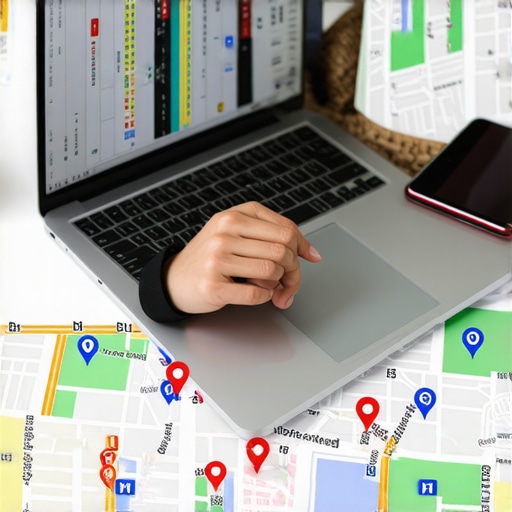
A single-point rank check (checking your rank from your office computer) is completely useless. Local SEO is spatial. You need to see how you rank on a grid across your entire city. We use SEO Viper Tools as our primary google maps rank tracker. This allows us to see a visual heatmap of exactly where our client’s “green pins” (Rank 1-3) turn into “red pins” (Rank 4+). By running these same heatmaps on competitors, we can identify their “weak zones” where their influence fades, giving us a clear target for our next expansion campaign.
Category 3: The Heavy Hitters
For deep-dive analysis, BrightLocal and Whitespark remain the industry gold standards. These tools allow us to track citation growth and audit the “NAP” (Name, Address, Phone) consistency of our rivals. Furthermore, Localith has emerged in 2026 as a powerhouse for multi-location AI management, helping us see how large franchises are automating their local updates. For smaller businesses, Moz Local is still a fantastic entry-point tool to ensure your foundational data is locked down across the web.
3 Specific “Moves” Your Competitors are Making (And How to Spot Them)
Competitive intelligence isn’t just about knowing who is winning; it’s about knowing how they are winning. Here are three common tactics we see in the wild today:
1. The 24/7 Hours Tactic
Have you noticed a competitor who never seems to leave the Map Pack, even at 2 AM? Some businesses set their hours to “24 Hours” to avoid being filtered out by Google’s “Open Now” filter. While this can be a risky move if you don’t actually answer the phone (leading to negative reviews and potential suspensions), it is a common way competitors steal leads during off-hours. If you see a competitor suddenly move up, check if they’ve changed their operating hours.
2. Primary Category Shifting
High-level SEOs play the “seasonal shift.” An HVAC company might use “Air Conditioning Repair Service” as their primary category in July, but switch to “Heating Contractor” in November. This subtle change in google business profile optimization can lead to a massive influx of relevant traffic. By monitoring category changes, you can stay ahead of seasonal trends rather than reacting to them. This is a key part of How to Find the Gaps in Local Competition and Take Their Map Spot.
3. Review Velocity and Keyword Extraction
Google’s AI now reads your reviews to understand what services you actually provide. If a competitor is suddenly ranking for “emergency water damage restoration” despite not having that in their description, look at their recent reviews. They are likely incentivizing or guiding customers to mention specific services and locations in their feedback. This “Review Justification” is a powerful ranking signal that many businesses overlook.
The 15-Minute Competitor Audit: A Step-by-Step Framework
You don’t need hours of free time to perform a high-level local competition analysis. Follow this 15-minute framework to see exactly where you stand:
- Minutes 1-3: Identify the Leaders. Search your primary keyword in an incognito window. Identify the top 3 businesses. These are your targets.
- Minutes 4-7: Category Check. Use a google business profile audit tool to see their primary and secondary categories. Are they using a category you missed?
- Minutes 8-10: Content Frequency. Look at their “Google Posts.” Are they posting daily? Weekly? Do their photos look professional or are they raw, “real-world” shots? (Hint: Google loves high-quality, authentic user-generated content).
- Minutes 11-15: Description Analysis. Read their “From the Business” section. Are they keyword stuffing, or are they using natural language to highlight their unique selling propositions?
If you find that your competitors are outperforming you in all these areas, it’s a sign that your profile is under-optimized. You might want to check out The 15-Minute Audit to Find Out Why Your Map Ranking Is Flatlining for a deeper diagnostic on your own profile.
Advanced Intelligence: Tracking Citations and Backlinks
While the Google Business Profile itself is the “face” of your local SEO, the “engine” often sits off-page. To truly outrank competitors google maps, you have to look at their digital footprint. Citations (mentions of your business on directories like Yelp, YellowPages, and industry-specific sites) act as votes of confidence for your location data.
Using Whitespark’s Citation Finder, we can see exactly which directories a competitor is listed on that we are missing. If they have a link from a local chamber of commerce or a neighborhood blog, that local relevance carries immense weight. Combining these off-page signals with high-quality local seo tools ensures that your profile has the “Prominence” required to rank in the 5 Moves That Force Your Google Business Profile into the Top 3. Don’t just focus on the profile; focus on the web of data that supports it.
The Future of Spying: AI and “Ask Maps” in 2026
As we move through 2026, the landscape is shifting from traditional search to AI-driven discovery. Google’s “Ask Maps” feature allows users to ask complex questions like, “Which plumber near me is best for old copper pipes and has the fastest response time?”
Google’s AI, along with tools like BirdAI, is now scraping your profile, your reviews, and your website to find these answers. This means your “spy” tactics must now include analyzing how AI perceives your competitors. Are they mentioned in local “Best Of” lists? Does the AI associate their brand with specific niche problems? To keep up, many agencies are now utilizing local seo automation tools to monitor these AI mentions in real-time, ensuring they remain the “suggested” answer for conversational queries. Staying ahead of this curve is what separates the market leaders from the businesses that simply disappear.
Conclusion: From Intelligence to Action
Data is only as valuable as the action it inspires. You can have the best google maps rank tracker in the world, but if you don’t use that data to adjust your categories, improve your review velocity, or fix your citations, you will stay exactly where you are. The “invisible war” for the Map Pack is won by those who are proactive, not reactive.
Stop guessing why your rankings are fluctuating. Start by performing How We Audited Local Competitors to Dominate the Map Pack and see the landscape for what it really is. If you’re ready to take the next step and want a professional google maps ranking service to handle the heavy lifting, the tools and strategies are ready for you. The Map Pack is waiting – will you take your spot, or let your competitors keep theirs?